Technology towards fault-tolerant photonic quantum computing
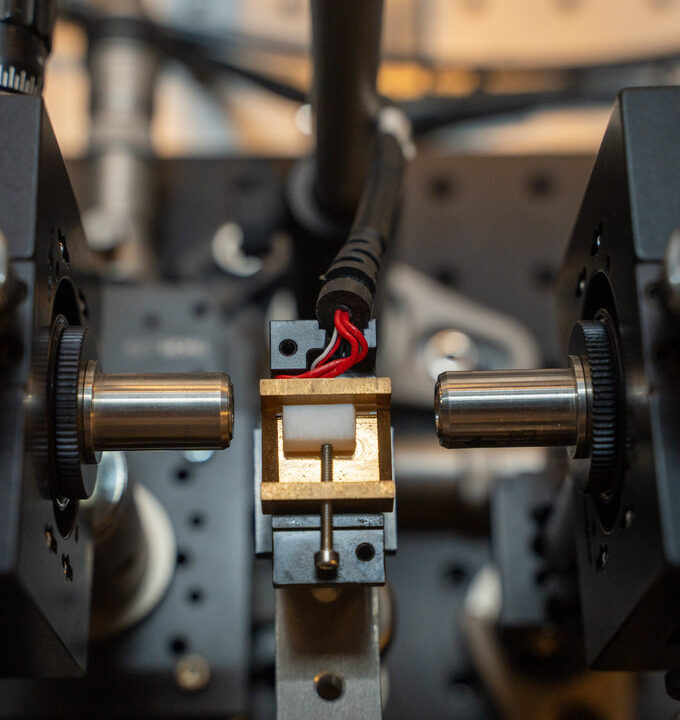
A measurement-based, continuous-variable photonic architecture built to scale
Qluster is a spin-off from the world-renowned Laboratoire Kastler Brossel. Our aim is to develop a Fault-Tolerant Photonic Quantum Computer designed to overcome the scalability and energy barriers of current quantum architectures.
Unlike static qubit systems that require extreme cryogenic cooling, Qluster utilizes Measurement-Based Quantum Computing paradigm. In this model, the computational power is decoupled from the hardware complexity by preparing a massive, highly entangled continuous-variable “cluster state” of light in advance.
Calculations are then executed using a sequence of adaptive measurements on this state, allowing the system to operate primarily at room temperature with industry-standard telecommunication components.
Hybrid photonic architecture
The core innovation lies in a unique hybrid photonic architecture that combines two distinct quantum light sources. The foundation of this technology is a continuous-variable, deterministic Gaussian-state photonic source capable of generating multi-mode squeezed light.
Developed through decades of expertise in continuous-variable (CV) quantum optics, this integrated waveguide technology generates millions of entangled temporal and frequency modes at high speeds (100 MHz) without the need for complex optical cavities.
To achieve universal and fault-tolerant computing, this continuous-variable photonic foundation will be hybridized with semi-deterministic light–matter interfaces that inject the non-Gaussian states required for universal computation and advanced error correction
Frequently Asked Questions
What makes Qluster’s quantum computer different from other quantum systems?
Qluster uses a continuous-variable photonic, measurement-based
architecture instead of static qubits, enabling operation mainly at room
temperature without extreme cryogenic cooling.
What is Measurement-Based Quantum Computing?
It is a quantum computing approach where a highly entangled “cluster state” of light is prepared in advance, and computations are performed through adaptive measurements on this state.
Why is photonic technology important for scalability?
Photonic systems use light instead of matter-based qubits, reducing energy consumption and allowing the generation of millions of entangled modes at high speed. In fact, photonics is becoming indispensable across the entire industry: even competing quantum platforms will ultimately rely on photonic links to interconnect their chips and achieve true scalability.
What do you mean by hybrid photonic architecture ?
Qluster will combine deterministic Gaussian-state photonic sources with semi-deterministic light-matter interfaces to enable universal and fault-tolerant quantum computing.
How does Qluster achieve fault tolerance?
The architecture will integrate non-Gaussian states and advanced error correction methods, improving reliability and stability for large-scale quantum computation.
Ready to explore the future of quantum computing?
Get in touch with our team to learn more about Qluster